OEM vs ODM in Eyewear: Which Manufacturing Model Is Right for Your Brand?
A practical guide to costs, control, and time-to-market for startups and established brands
You have a vision—a distinctive frame shape, a unique material combination, or a completely new brand identity. Then comes the first major supply chain decision: OEM or ODM? For many eyewear entrepreneurs and brand managers, these two acronyms feel like a fork in the road with no clear signposts.
This guide cuts through the jargon. We'll evaluate control, cost structure, timeline, and risk—four dimensions that matter most to your business. By the end, you'll have a clear framework to choose the path that aligns with your brand's current stage and future goals.
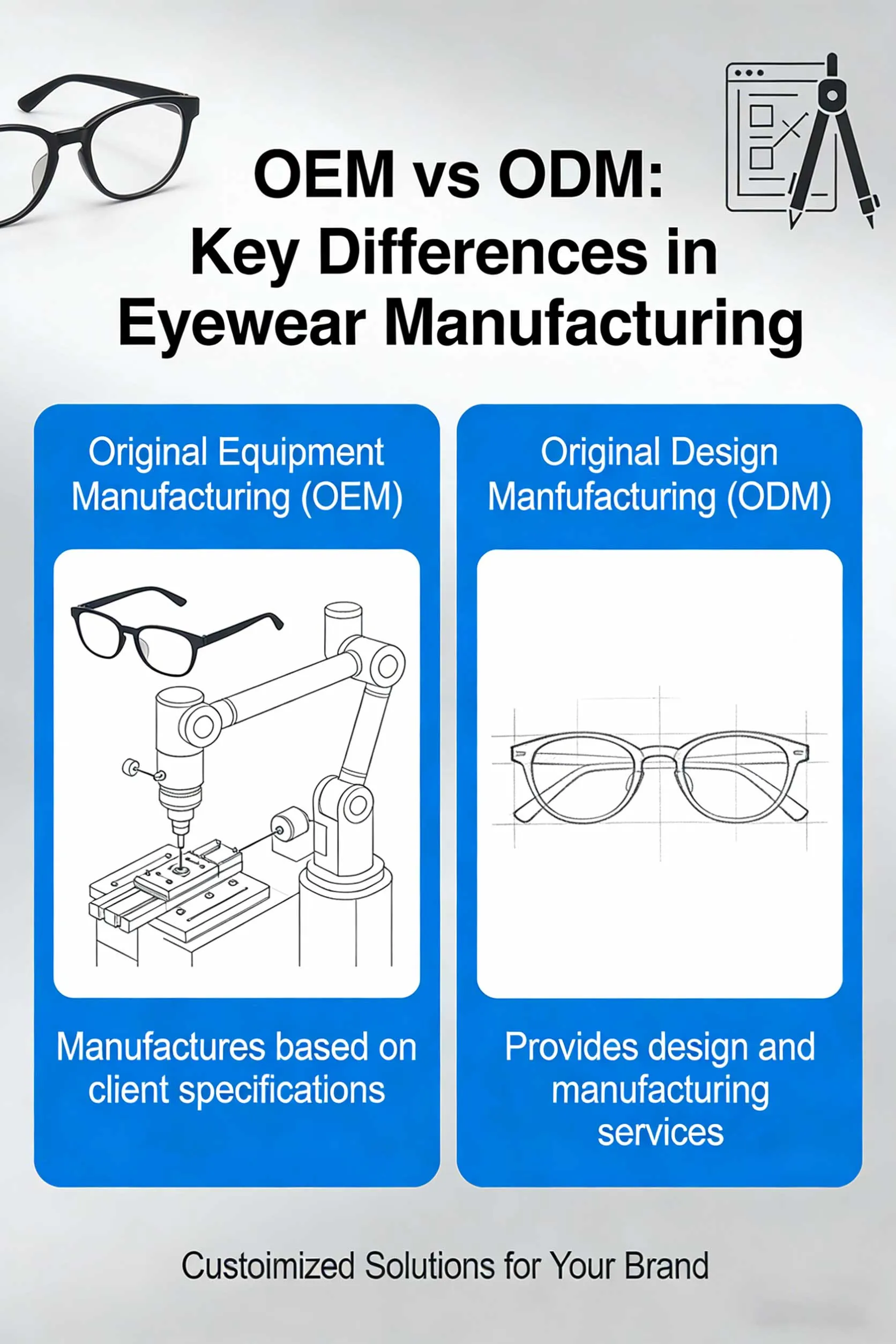
1. What Do OEM and ODM Really Mean?
OEM
Original Equipment Manufacturing
You own the complete design and specifications. The manufacturer's role is to produce exactly according to your drawings, material list, and quality standards.
Best for: Brands with ready-to-produce designs, established engineering resources, and a need for precise control over every component.
ODM
Original Design Manufacturing
You bring ideas and concepts; the manufacturer provides the full design-to-production service. This includes structural engineering, material selection assistance, and prototyping.
Best for: Startups, designers with creative concepts but limited eyewear engineering experience, or brands looking to expand collections efficiently.
🍳 Simple analogy: OEM is like cooking from a detailed recipe you wrote. ODM is like working with a chef who understands your taste and creates the dish with you. Check Hala ODM/OEM service and processes.
2. Four Dimensions Compared: OEM vs ODM
| Dimension | OEM | ODM |
|---|---|---|
| Design Control | Complete ownership. Every curve, dimension, and material is defined by you. | Collaborative. You define concept and aesthetics; manufacturer engineers the structure. |
| Cost Structure | Higher upfront design investment (in-house designers, multiple samples). More predictable per-unit cost. | Lower design-phase investment. Per-unit cost may include slight premium to cover development work. |
| Time to Market | Depends on your design readiness. Faster if specs are complete; delays if design needs iteration. | Involves design collaboration, but manufacturer's experience prevents “unmakeable” design dead-ends. |
| Risk Allocation | You bear design risk (e.g., structural flaws). Manufacturer bears production quality risk. | Shared risk. A capable manufacturer flags potential issues during design phase, reducing costly changes later. |
3. How to Choose Based on Your Brand Stage
OEM may be the right fit if…
- ✓ You have complete technical drawings (CAD) and a clear bill of materials.
- ✓ Your team has eyewear engineering or supply chain experience.
- ✓ You want full intellectual property ownership from the first sample.
- ✓ You plan to scale quickly and want to manage multiple suppliers independently.
ODM may be the right fit if…
- ✓ You have a clear brand concept and visual direction but no technical eyewear expertise.
- ✓ You are launching a first collection and want to minimize upfront design investment.
- ✓ You value a manufacturer's input on materials, structural durability, and wearability.
- ✓ You want a single partner to manage from concept to finished product.
4. Real-World Scenarios: Different Brands, Different Choices
SCENARIO 1
OEM in action: An established apparel brand enters eyewear
A well-known clothing brand has an in-house design team that creates detailed CAD files for a sunglass collection. They need a manufacturing partner who can follow precise specifications, maintain consistent quality across multiple SKUs, and meet strict seasonal deadlines.
For them, the ideal OEM partner provides:
- Accurate execution of provided technical drawings
- Rigorous quality control at each production stage
- Clear communication on production timelines and logistics
This is where capabilities like multi-point inspection and reliable global shipping become critical differentiators.
SCENARIO 2
ODM in action: An independent designer launches a first collection
A creative director has distinctive sketches—bold geometric shapes and a mix of acetate and titanium—but no background in frame engineering. They need a partner to translate these concepts into structurally sound, comfortable eyewear that can be manufactured efficiently.
For them, the ideal ODM partner offers:
- Design consultation to refine concepts for manufacturability
- CAD drawing and 3D modeling to visualize the final product
- Material and structural recommendations without compromising the original vision
- Prototyping and iterative feedback until the sample is approved
A partner who combines design support with production expertise helps turn creative risk into market-ready products.
5. Beyond the Acronym: Choose a Partner, Not Just a Model
OEM and ODM exist on a spectrum. The more important question isn't which label to pick, but whether your manufacturing partner provides the right support for your current stage—and can grow with you.
A reliable manufacturing partner demonstrates:
- 🔍 Technical transparency – Openly discussing structural limitations, cost drivers, and alternatives.
- 📋 Process clarity – Clear milestones (CAD review, sample approval, production) and consistent communication.
- ✅ Quality consistency – Documented internal inspections and optional third-party verification.
- 🔄 Long-term flexibility – Ability to transition from ODM to OEM as your brand's internal capabilities grow.
6. Start with Your Brand's Reality
There is no universally "better" model—only the one that aligns with your resources, timeline, and vision. Many successful eyewear brands began with ODM to bring their first collection to market efficiently, then gradually shifted to OEM as they built internal design and sourcing capabilities.
What matters most is finding a partner who is transparent about what they can deliver, communicates clearly throughout the development process, and treats your brand's success as their own.
✨ Not sure which path fits your brand? A focused conversation about your concept, timeline, and goals can provide clarity. Reach out for an initial consultation — no obligation, just a roadmap to help you decide.
Before You Start: A Quick Self-Checklist
If some answers are uncertain, that's normal. A good manufacturing partner will help you fill in the blanks.